
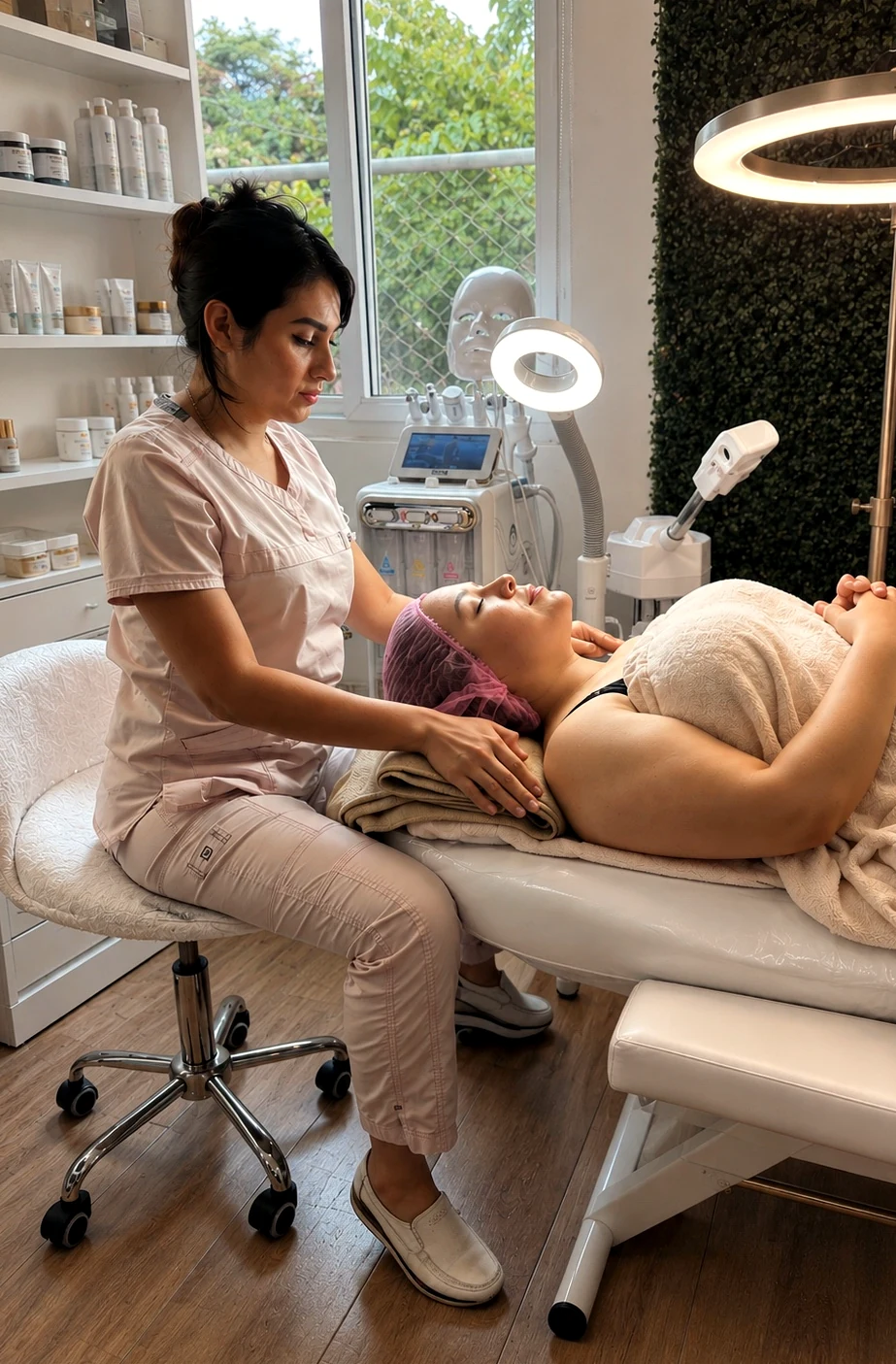
What dermaplaning is
Dermaplaning is a superficial exfoliation performed with a sterile tool. It helps remove dead cells and fine facial hair from the face.
It can be a good option for people who want smoother skin, more luminosity, improved appearance of superficial texture, and more even makeup application.
How it is different from shaving
Household shaving is designed mainly to cut hair.
Dermaplaning is a professional treatment that uses a sterile tool to carefully remove fine facial hair and dead cells accumulated on the surface of the skin. This helps the face feel smoother and look more luminous.
Although both remove superficial hair, professional dermaplaning also provides controlled exfoliation of dead cells.
Who may not be a candidate
It may not be appropriate during active inflammatory breakouts, irritation, wounds, or some skin conditions.
It is not recommended to pass the tool over inflamed acne or open lesions. The skin should be evaluated first.
Common myths
Myth: hair will grow back thicker.
Dermaplaning does not change the structure, amount, or color of the follicle. The hair may feel different as it begins to grow because it was cut evenly, but it does not become thicker.
Myth: it is the same as shaving at home.
Although both remove superficial hair, professional dermaplaning also provides controlled exfoliation of dead cells.
Myth: everyone can do it.
Not always. The skin should be evaluated first, especially if there is inflammatory acne, irritation, or an active condition.
Myth: it removes deep scars.
It may temporarily improve smoothness and superficial appearance, but it does not eliminate deep scars.
Before and after care
Before your appointment, avoid exfoliating the skin, do not wax the face immediately before, and share whether you use retinol, acids, or dermatology medications.
After dermaplaning, Emily recommends waiting approximately 24 hours before makeup. During that time, keep the skin clean, hydrated, and protected with sunscreen.